
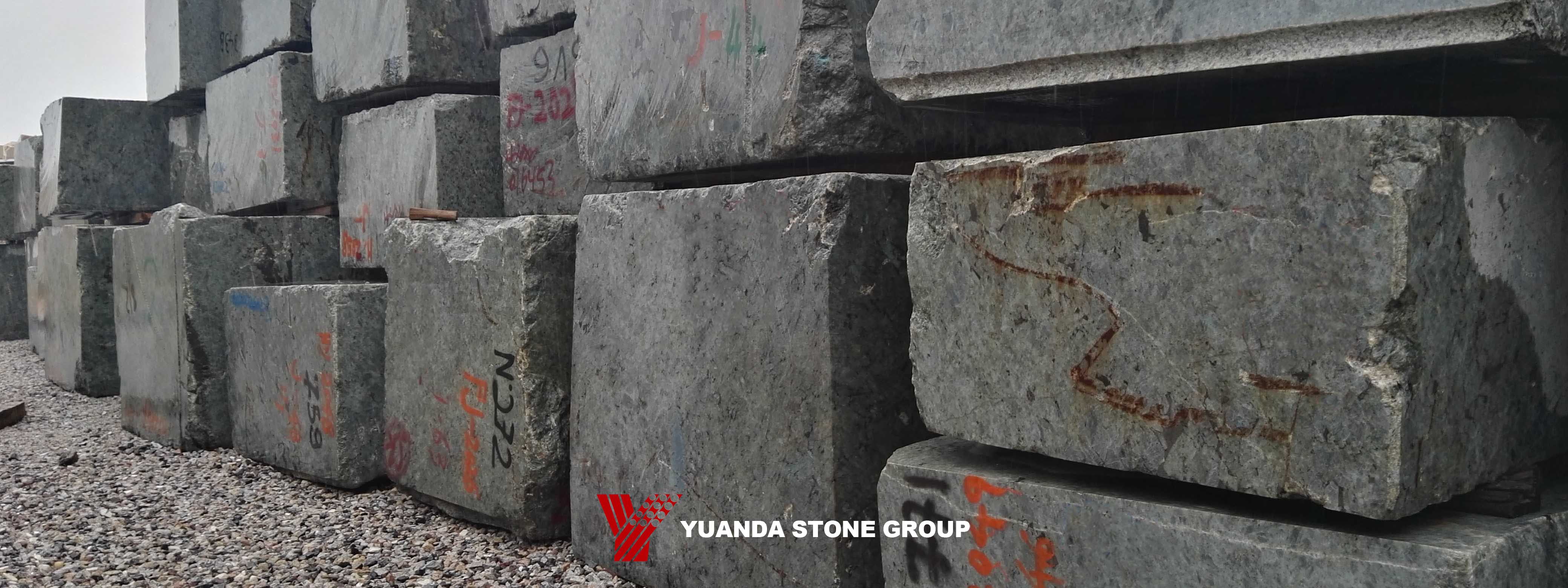
What exactly is Labradorite Blue Granite?
Labradorite Blue Granite is a coarse-grained, dark-coloured igneous rock in which the dominant mineral is labradorite, a plagioclase feldspar. The rock itself is generally classified by geologists as anorthosite; "granite" is the commercial category stone yards use for hard, silicate-based material, not a statement about its mineral composition.
The colour is not a pigment. Labradorite contains microscopic twinning lamellae — alternating ultra-thin layers inside the crystal — and light reflecting between those layers interferes with itself. Different wavelengths cancel or reinforce at different viewing angles, which is why the stone appears near-black head-on and lights up blue, teal or occasionally gold as you move past it.
Because the same material travels under many names, buyers comparing quotations should confirm slab identity rather than labels. The most common trade names in the international market are Lemurian Blue, Blue Emerald, Blue Jade and Labradorite Blue. They are not four different stones in every case.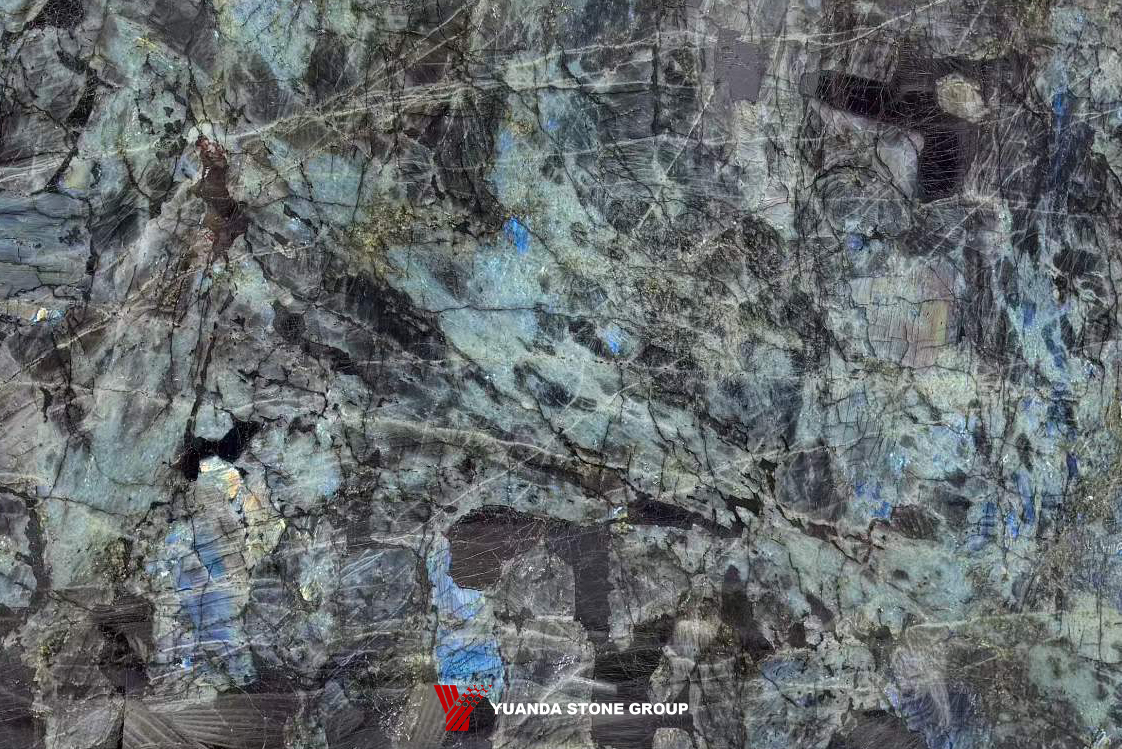
Why does the stone change colour when you move?
Labradorescence is an optical property of the mineral, not a surface coating and not a lighting trick. Three practical consequences follow:
- Photographs under-represent it. A still image captures one angle. Clients who select from a photo often receive a slab that looks calmer — or more dramatic — in the room than on screen.
- Sample size matters. A 100 × 100 mm sample cannot show the flash pattern of a 3 m island. Selection should happen on the full slab, ideally in daylight.
- Lighting design changes the result. Directional light, cove lighting and wall-washing all affect how much blue appears. This is why the stone performs so well beneath under-cabinet lighting and in rooms with grazing light along a wall.
Where is it quarried, and why does origin matter?
Commercial supply comes primarily from Madagascar. The stone occurs in blocks, and the flash pattern is not consistent from block to block — density, chip size and the balance between blue, teal and gold all shift.
For a single-surface project this is manageable. For a project using several slabs on adjacent walls or a matched island and backsplash, the slabs should come from the same block, cut sequentially, so the pattern can be aligned at the seam. Bookmatching — mirroring two consecutive slabs — is the standard technique for producing a symmetrical "butterfly" layout on an island or a full-height wall.
Is it granite, marble, or something else?
It is not marble, and this distinction has maintenance consequences rather than marketing ones.
In practice: the stone resists the acid etching that owners of marble countertops learn to fear, but it is softer than quartz-based engineered surfaces and will show scratches if heavy items are dragged across it.
How does it perform on a kitchen countertop?
The table below summarises behaviour typical of polished labradorite-bearing stone. Slab-specific test data should always be requested from the supplier before a project is signed off.
One caveat specific to this stone: the flash is a surface-optical effect, so aggressive re-polishing in the wrong direction can dull the iridescence. Repairs should be handled by a fabricator experienced with labradorite.
Where it works best — and where it does not
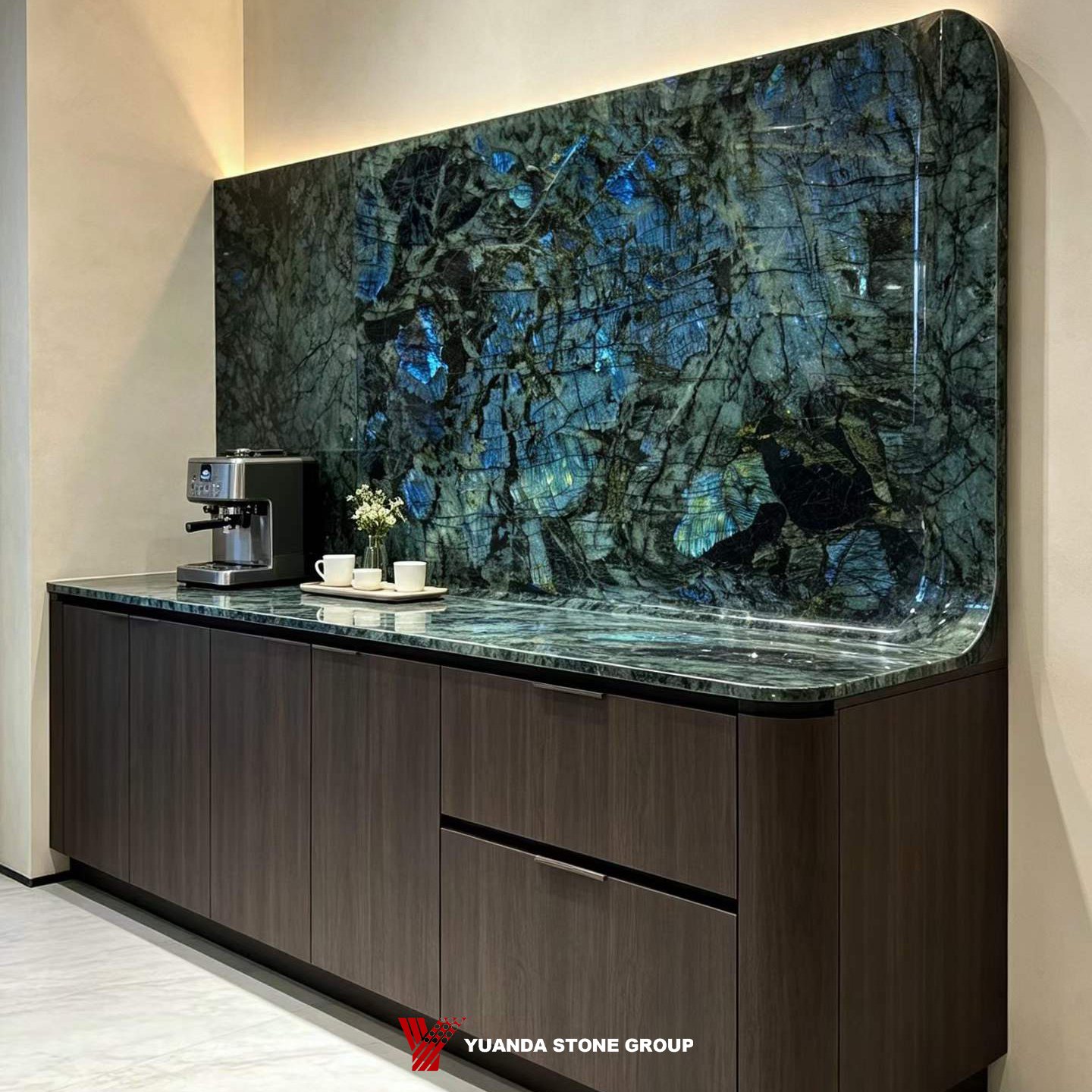
Strong applications
- Waterfall kitchen islands, where the pattern folds down the two ends
- Full-height backsplashes and bar backs, particularly with concealed cove lighting
- Bar fronts and reception desks viewed from a distance
- Fireplace surrounds, especially bookmatched pairs
- Powder room vanities and vessel basins carved from a single block
Weaker applications
- High-traffic commercial kitchens where scratch resistance outranks appearance
- Budget-driven projects — block scarcity and bookmatch requirements add cost
- Rooms with flat, uniform overhead lighting, where the flash never gets an angle to work with
- Projects where the client has approved the material from a photograph only
How to specify it: five decisions
- Slab selection. Select in person, on the full slab, in natural light. Approve a specific slab number, not a material name.
- Block matching. For multi-slab projects, confirm the slabs are sequential from one block and reserve bookmatch pairs at order stage.
- Finish. Polished maximises the flash and is the usual choice. Honed reads quieter and hides fingerprints better but reduces iridescence.
- Thickness and edge. 20 mm and 30 mm are the standard countertop thicknesses; the choice affects edge profile options and substrate requirements rather than appearance alone.
- Protection and maintenance. Specify a penetrating sealer at fabrication, and agree a maintenance schedule with the owner in writing.
What drives the price
There is no single market price for Labradorite Blue Granite, and any quotation that does not reference a specific slab lot should be treated as indicative. Cost is driven by four variables: block rarity and yield, whether matched or bookmatched pairs are required, fabrication complexity (waterfall ends, radiused corners, sink cut-outs), and freight distance from Madagascar to the project site. Material selected for a statement wall costs more per square metre than utility-grade material from the same quarry, because the slab that carries the best flash cannot be sold twice.
Frequently asked questions
Is Labradorite Blue Granite suitable for kitchen countertops? Yes. It is hard, low-porosity and acid-resistant compared with marble, which makes it practical for kitchen work. The main considerations are scratch protection and sealing rather than chemical damage.
Does it stain or etch? It resists acid etching because it is a silicate stone, not a carbonate. Staining is possible from pigments such as turmeric, ink or red wine, particularly on honed surfaces, and is best addressed by prompt wiping and periodic resealing.
Is Lemurian Blue the same stone? Lemurian Blue is one of several trade names applied to labradorite-bearing material from Madagascar. Names vary by importer and are not a reliable indicator of quality; the slab lot and block number are.
Can it be used in a bathroom? Yes. It is commonly used for vanity tops, vessel basins carved from solid blocks and shower feature walls. Sealing is recommended, and slip resistance should be checked if it is used on the floor.
How should it be cleaned? Neutral pH stone cleaner and a soft cloth. Acidic cleaners are not required and abrasive powders should be avoided. Re-seal according to the fabricator's schedule — typically every one to two years in a busy kitchen.
About the material programme
YuanDa Stone Group supplies Labradorite Blue Granite as full slabs, matched and bookmatched pairs, and cut-to-size countertops, vanity tops and cladding panels. Slab photography, block numbers and availability are provided on request so that specifiers can approve the exact material before fabrication.